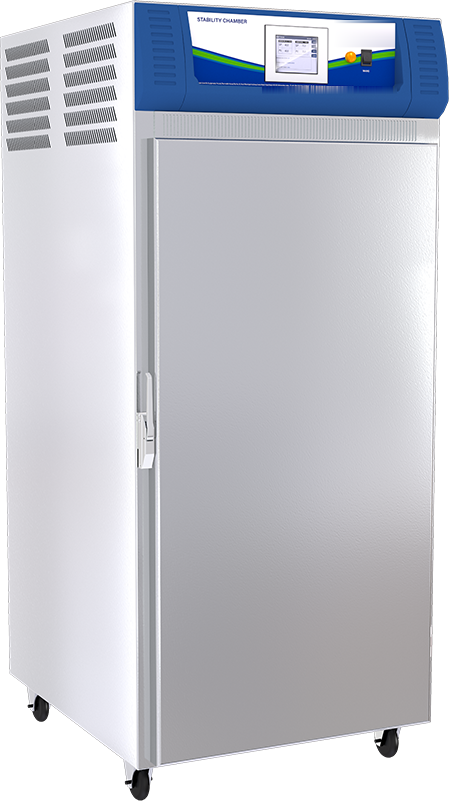
Stability testing is a mandatory stage in the development and registration of medicinal products. The reliability of shelf-life data depends on how precisely the chamber maintains the set conditions. Here is what to look for when choosing a stability chamber.
1. Which test conditions you need
Start with the list of ICH Q1A conditions you plan to use. The most common are 25 °C / 60 % RH for long-term studies, 30 °C / 65 % RH or 30 °C / 75 % RH for intermediate studies and hot-climate markets, and 40 °C / 75 % RH for accelerated studies. If you need several conditions at once, consider several chambers or a dual chamber with two independent zones.
2. Volume and number of samples
Estimate how many samples, in which packaging, you will store over the whole study, with a margin for new products. Cabinet chambers suit smaller labs; for large volumes, walk-in rooms built to fit your space are the better choice.
3. Uniformity and stability of conditions
Not only sensor accuracy matters, but also the uniformity of temperature and humidity throughout the chamber. Ask the supplier for mapping data and the permitted deviations at different points in the chamber.
4. Monitoring, alarms and data integrity
- continuous recording of temperature and humidity;
- audible and remote deviation alerts;
- software with access control and an audit trail;
- standby humidification and refrigeration systems for critical studies.
5. Photostability
If the product is light-sensitive, you will need an ICH Q1B photostability chamber with daylight and near-UV exposure and dose control.
6. Qualification and service
The chamber must be qualified before testing starts. Check whether the supplier provides qualification documentation, installation, commissioning, operator training and maintenance.
AT Engineering will help you select a stability chamber or walk-in room for your test conditions and sample volumes. Contact us — describe your task and we will send a quotation.