Category: Articles

Practical articles from AT Engineering engineers on pharmaceutical equipment, tooling and spare parts.

  • Annex 1 and isolators: what has changed for aseptic manufacturing

    Annex 1 and isolators: what has changed for aseptic manufacturing

    The revised EU GMP Annex 1 “Manufacture of Sterile Medicinal Products” came into force on 25 August 2023. It significantly tightened requirements for aseptic manufacturing and made barrier technologies — isolators and RABS — the preferred way to protect the product. Here is what this means when choosing equipment.

    Contamination control strategy

    Annex 1 requires a contamination control strategy (CCS) covering the whole process: premises, equipment, personnel, materials, cleaning and decontamination, and monitoring. An isolator or RABS is a key element of this strategy, so it is selected for the process and the cleanroom rather than in isolation.

    Isolator or RABS

    • Isolator — a fully closed system with a controlled Grade A environment and its own automated bio-decontamination. It minimises operator impact and allows the equipment to be placed in a lower-grade room.
    • RABS — a restricted access barrier system. Grade A inside, but the background room must be at least Grade B. Often chosen for upgrading existing lines.

    Background cleanroom grade

    For open isolators the background should generally be at least Grade C, for closed isolators at least Grade D, and for RABS at least Grade B. This choice drives the cost of cleanrooms, gowning and monitoring.

    Bio-decontamination

    The internal surfaces of an isolator undergo validated bio-decontamination — most often with vaporised hydrogen peroxide (VPHP). The cycle must be reproducible and confirmed with biological indicators. Materials are transferred through pass-through chambers with bio-decontamination and RTP ports.

    Gloves — the weakest point

    Gloves and ports are the most likely point of barrier failure. Annex 1 requires regular visual inspection and physical leak testing of the glove system, typically at the beginning and end of each batch or campaign. Automatic glove and RTP port leak testers help here, as do gloves made of materials compatible with decontamination and process substances.

    What to consider when choosing

    • process: aseptic filling, sterility testing, HPAPI handling, cell therapy;
    • whether the operator needs protection, not only the product (this defines the isolator pressure);
    • the grade of existing rooms and whether it can be changed;
    • bio-decontamination and material transfer method;
    • glove integrity testing and data integrity (21 CFR Part 11).

    AT Engineering supplies isolators and RABS, pass-through chambers with bio-decontamination, integrity testing systems and isolator gloves. Describe your process and cleanroom grade and we will propose a configuration.
  • Tablet tooling care: how to extend the life of punches and dies

    Tablet tooling care: how to extend the life of punches and dies

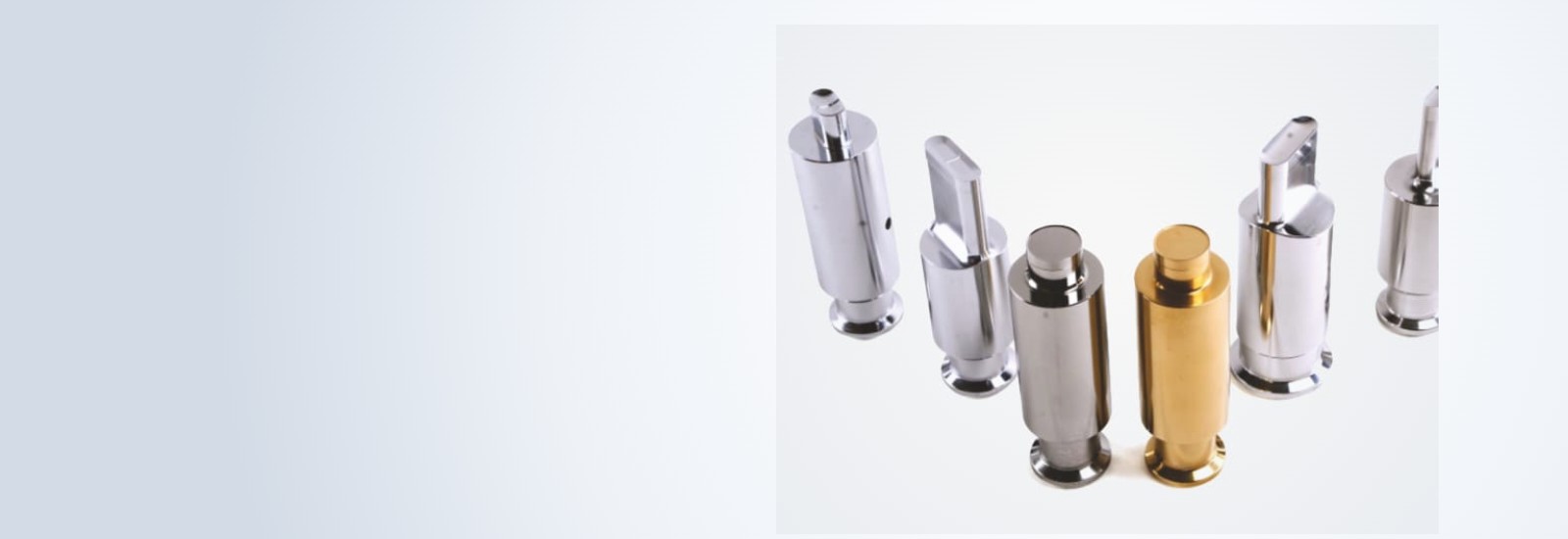
    Punches and dies are the most precise and most expensive part of a tablet press, and tablet quality depends on their condition. Proper care extends tool life and reduces rejects and stoppages. Here is what tablet tooling maintenance consists of.

    1. Cleaning after every product changeover

    Residues of product and lubricant on the tools cause corrosion and sticking. Tools are cleaned straight after use — by hand or in ultrasonic baths — and dried thoroughly.

    2. Inspection and measurement

    After cleaning, every punch is inspected for scratches, chipped edges, wear of the tip face and embossing. The working length of the punches is measured regularly — length variation within a set directly affects tablet weight and hardness.

    3. Polishing

    Polishing restores a smooth tip face and often solves sticking. Do not overdo it: excessive polishing changes the cup geometry and embossing.

    4. Lubrication and corrosion protection

    Before storage, tools are coated with a protective oil compatible with your production requirements. This is especially important for tooling made of standard tool steels.

    5. Storage and transport

    Punches must not touch each other: use individual trays or cabinets with compartments for storage and protective cases for transport. Each set is tracked under its own number with a history of use and measurements.

    When to replace tooling

    • working length is out of tolerance or variation within the set no longer allows weight and hardness to be held;
    • embossing is worn and cannot be restored by polishing;
    • edges are chipped, or the surface has deep scratches or corrosion;
    • sticking persists after polishing.

    AT Engineering supplies tablet press tooling and tool care equipment for inspection, polishing, cleaning and storage. Read about the causes of sticking in our article on tablet sticking to punches. Contact us and we will select a solution for your production.

  • How to order tablet press spare parts quickly: what to send your supplier

    How to order tablet press spare parts quickly: what to send your supplier

    When a tablet press stops because of a worn part, every day of downtime is expensive. Most of the time is usually spent not on delivery but on identifying exactly which part is needed. Here is what to send your supplier so that parts selection takes as little time as possible.

    1. Machine details

    • Make and model — including the version: different versions of the same series may use different parts.
    • Serial number and year of manufacture — a photo of the machine nameplate is best.
    • Number of stations and turret type, if the machine has been modernised or the turret replaced.

    2. Part details

    • Part number from the manufacturer’s manual or spare parts catalogue.
    • Position on the drawing — a photo or scan of the catalogue page with the part marked.
    • Photos of the part from several sides next to a ruler, plus the main dimensions.
    • Where the part is fitted: compression unit, feeder, drive, lubrication system, electronics.

    3. Tooling needs its own set of data

    • tooling standard (EU, TSM or other) and punch type;
    • tablet drawing: shape, dimensions, score line, embossing;
    • number of sets and the coating required if you have sticking problems.

    4. Quantity and lead time

    State how many parts you need and how urgently. For wear parts it pays to build a planned maintenance kit straight away, so the next replacement does not stop production.

    5. If the original part is not available

    For machines that are no longer produced, a compatible alternative can be found or the part can be made from a sample or drawing. In that case we need the worn part itself or its exact dimensions and material.

    Quick checklist

    • make, model, serial number (nameplate photo);
    • part number or catalogue page;
    • photos and dimensions of the part;
    • quantity and required lead time.

    AT Engineering supplies tablet press spare parts and tooling for Fette, Korsch, Kilian, Manesty, IMA, GEA Courtoy, ACG, RTM, ZP and other machines. Send your details via the contact form or on WhatsApp, Viber or Telegram: +380 95 193 04 27 — we will select the parts and send you a quotation.

  • Thermoforming or cold forming: how to choose a blister machine

    Thermoforming or cold forming: how to choose a blister machine

    The blister is the most common pack for tablets and capsules. Choosing a blister machine starts with the question of which blister your product needs, and only then output and format. Here are the main criteria.

    Thermoforming (PVC/ALU)

    Cavities are formed from heated polymer film — PVC, PVC/PVDC and others. It is the most economical option, with transparent cavities that show the product. It suits most tablets and capsules that are not highly sensitive to moisture and light.

    Cold forming (ALU/ALU)

    Cavities are drawn from multilayer aluminium foil without heating. This blister gives almost complete protection against moisture, oxygen and light, so it is chosen for hygroscopic and light-sensitive products. Cavities are larger, so more material is used per blister.

    Combined machines

    If your portfolio includes different products, consider a machine that handles both thermoforming and cold forming after a change of format parts.

    What else to consider

    • Output: blisters or cycles per minute for your production volume.
    • Forming area: how many blisters are formed per cycle and whether your sizes fit.
    • Changeover: how quickly format parts can be changed if you run many products.
    • Product feeding: tablets, capsules, ampoules, vials and syringes each need different feeding systems.
    • Quality control: fill inspection cameras, printing and coding.

    AT Engineering supplies blister machines for tablets, capsules, ampoules and syringes, as well as blister machine change parts. Contact us — describe your product and blister format and we will find a solution.

  • How to choose a stability chamber for a pharmaceutical lab

    How to choose a stability chamber for a pharmaceutical lab

    Stability testing is a mandatory stage in the development and registration of medicinal products. The reliability of shelf-life data depends on how precisely the chamber maintains the set conditions. Here is what to look for when choosing a stability chamber.

    1. Which test conditions you need

    Start with the list of ICH Q1A conditions you plan to use. The most common are 25 °C / 60 % RH for long-term studies, 30 °C / 65 % RH or 30 °C / 75 % RH for intermediate studies and hot-climate markets, and 40 °C / 75 % RH for accelerated studies. If you need several conditions at once, consider several chambers or a dual chamber with two independent zones.

    2. Volume and number of samples

    Estimate how many samples, in which packaging, you will store over the whole study, with a margin for new products. Cabinet chambers suit smaller labs; for large volumes, walk-in rooms built to fit your space are the better choice.

    3. Uniformity and stability of conditions

    Not only sensor accuracy matters, but also the uniformity of temperature and humidity throughout the chamber. Ask the supplier for mapping data and the permitted deviations at different points in the chamber.

    4. Monitoring, alarms and data integrity

    • continuous recording of temperature and humidity;
    • audible and remote deviation alerts;
    • software with access control and an audit trail;
    • standby humidification and refrigeration systems for critical studies.

    5. Photostability

    If the product is light-sensitive, you will need an ICH Q1B photostability chamber with daylight and near-UV exposure and dose control.

    6. Qualification and service

    The chamber must be qualified before testing starts. Check whether the supplier provides qualification documentation, installation, commissioning, operator training and maintenance.

    AT Engineering will help you select a stability chamber or walk-in room for your test conditions and sample volumes. Contact us — describe your task and we will send a quotation.

  • Tablet sticking to punches: causes and how to fix it

    Tablet sticking to punches: causes and how to fix it

    Sticking is one of the most common problems in tablet compression. Powder particles stay on the punch tip face, tablets get surface defects, embossing becomes blurred, and rejects and cleaning stops increase. Here is where sticking comes from and how to eliminate it.

    How to recognise sticking

    • dull spots, dents or “picking” appear on the tablet surface;
    • letters and logo embossing fill with powder and become blurred;
    • a film builds up on the punches with every hour of operation;
    • ejection force and rejects increase over time.

    Main causes

    1. Formulation and powder properties

    High granule moisture, hygroscopic or low-melting components, too little lubricant or its uneven distribution are the most common causes of sticking. Particle size and the amount of fines also matter.

    2. Condition of the punch tip face

    Scratches, micro-wear and corrosion on the tip face hold on to powder particles. Even new tooling can cause sticking if it is not properly polished.

    3. Tablet geometry and embossing

    Deep or fine embossing, sharp letter corners, small “islands” inside characters (as in A, O, R) and a poorly designed break line create areas where powder sticks most.

    4. Process parameters and environment

    Insufficient compression force, high turret speed, and high room humidity and temperature also promote sticking.

    How to eliminate sticking

    • Check the formulation: granule moisture, lubricant content and blending method, particle size distribution.
    • Polish the tooling: regular polishing of the tip faces restores smoothness and often solves the problem.
    • Change the punch coating: chrome plating, titanium nitride (TiN), chromium nitride (CrN) and other coatings reduce adhesion.
    • Optimise the embossing: change the font, depth and wall angle, increase radii, remove fine details.
    • Adjust the parameters: compression force, turret speed, room conditions.

    Prevention

    A proper tooling care routine — cleaning after every product change, inspection, polishing and correct storage — greatly reduces the risk of sticking and extends the life of punches and dies.

    AT Engineering engineers will help identify the cause of sticking and find a solution: coating, polishing or new tooling with optimised embossing. We also supply tablet press spare parts and carry out tablet press modernisation. Contact us — send photos of the tablets and punches and we will propose a solution.

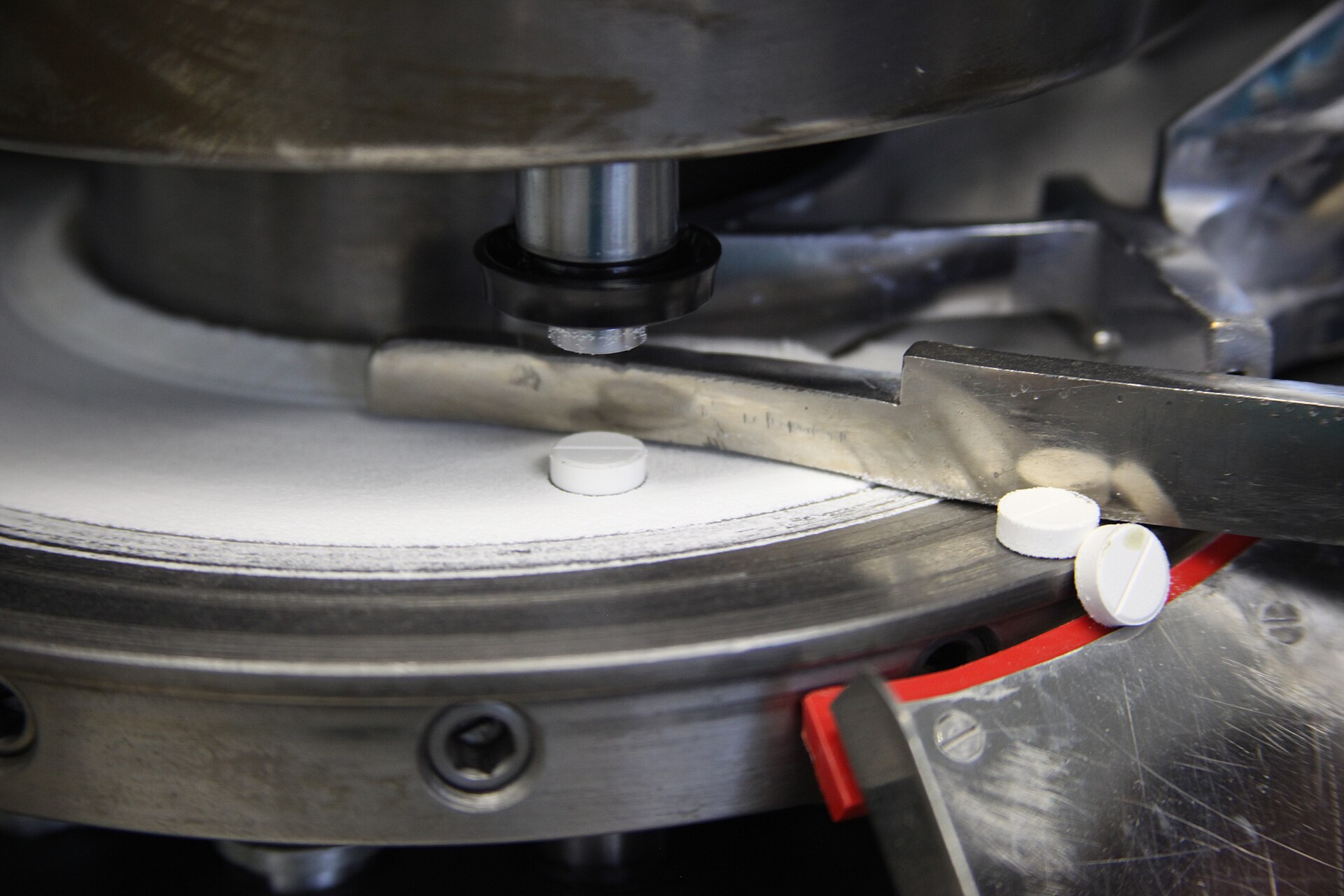
    Photo at the top: Robin Müller, Wikimedia Commons, licence CC BY-SA 3.0.